
Recent Works


Introduction
In India, around 85% of the farmers are small and marginal farmers. The agricultural sector in India is hampered by high transaction costs and low access to credit and agricultural produce markets. There are several legal entities which aim to help farmers reap benefits of economies of scale via aggregation like farmer cooperatives, farmers clubs, farmer interest groups, etc. Farmer Producer Organisations (FPOs) are one such farmers’ aggregate. An FPO can be registered under several legal forms like cooperatives, producer companies, Section 8 company, societies or public trusts. FPOs registered under the Indian Companies Act, 1956 are known as Farmer Producer Companies (FPCs). This post points out the various issues faced by FPOs and provides recommendations on how to address these issues. It is divided into two sections. The first section reviews the status of FPOs in India while the second section discusses the current institutional interventions and recommendations going forward.
Section I
The Preamble of the National Policy for Promotion of FPOs envisions FPOs in various roles. They are to be used as implementing agencies for various agricultural development programmes, linked to Financial Institutions (FIs), and promoted at par with member-owned institutions like cooperatives and Self Help Groups (SHGs). Before maturing to a point where it is a self-sustainable and self-governing body, an FPO usually goes through 3 stages in its life-cycle as demonstrated below.

The policy push has been for increasing the number of FPOs and using the number of FPOs as a proxy for agricultural development. As the figure below showcases, there has been a drastic increase in the number of FPCs registered 2012 onwards. Currently, there are 5000 FPOs in the country of which 3200 are registered as FPCs. Most of these FPOs are still at a nascent stage and sustaining on grants. NABARD is set to promote 5000 more FPOs in the coming 2 years. The imperative is shifting towards making the existing FPOs self-sustainable by building better business model rather than concentrating purely on scaling up. If we consider the current programmes and schemes targeted at FPOs, they fall short of covering the spectrum of risks faced. The present guidelines do not treat FPOs and farmers at par with each other. There are significant barriers to access to credit and regulatory compliances which are difficult for nascent FPOs to meet.
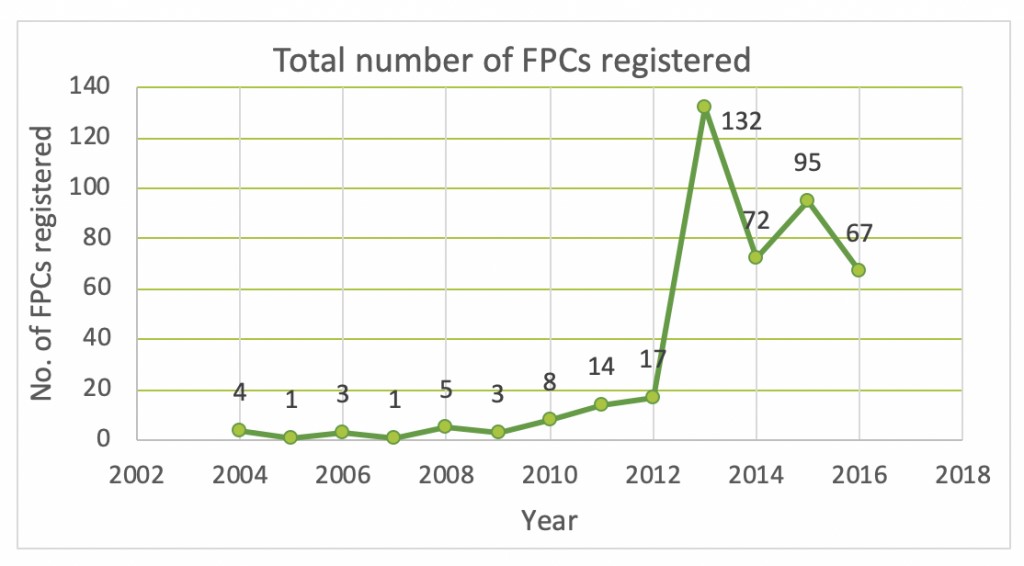
Source- Navaneetham et al. (2017)
Treating all farmer aggregates at par with each other and individual farmers
The initial barriers to the growth of FPOs emerge from their differential legal treatment. Farmers and farmer aggregates do not have access to the same kind of benefits. Even within FPOs, there’s differential treatment between FPOs registered as companies and FPOs registered as cooperatives. All agricultural income is exempt from income tax, but the income of a farmer aggregate like an FPC is taxed. FPOs registered as cooperatives are entitled to income tax deductions as per Section 80P of the Indian Income Tax Act. Co-operatives that opt to convert into Producer Companies would still be entitled to all tax and other concessions that they had as co-operatives. But entities registered as FPCs are not entitled to any of these benefits. Removing these discrepancies would give a significant boost to the growth and development of these FPOs. All FPOs should be granted income tax exemption at least for the initial five years to enable them to build surplus and reserves. Further, in lieu of the statutory compliances FPOs are bound by under their respective registration Acts, relief to FPOs from a penal provision in case of certain non-compliances for the first five years would boost growth.
Treating FPOs as agri-start ups
According to a NABARD report on credit issues of farmers, a farmer is “a risk-taking entrepreneur who faces uncertainties from weather, spurious inputs, pests and diseases, and market shocks among other risks”. A start-up, as defined by the Startup India scheme, is an entity that’s registered as a private limited company, partnership firm or a limited liability partnership in India. It has a maximum vintage of 7 years, 10 years for the biotechnology sector, from the date of its incorporation. Its turnover for any of the financial years should not exceed INR 25 Crores. Lastly, it must be working towards innovation, development or improvement of products or processes or services, or should be a scalable business model with a high potential of employment generation or wealth creation. Provided an entity qualifies all the specified criteria, it opens the doorway to a host of benefits. These range from tax exemption on capital gains for investors, tax exemptions to start-ups for the initial 3 years, favourable public procurement norms, and easier access to funds. By extension of both these definitions, FPOs are akin to agri-start ups. FPOs should thus be given access to similar if not the same benefits, as specified above. The case here is not for constant handholding, but for providing support in the initial years and progressively introducing regulatory compliances as the FPO matures.
Section II
Incentivising institutional lenders to provide credit to FPOs
On the demand side, raising debt is a huge issue for FPOs as most FIs require collaterals and at least three years of balance sheets for credit assessment. The skilled manpower to provide such documentation or the funds to hire the same is not readily available for an FPO. Additionally, due to accumulated losses in the initial few years, they are likely to have a relatively low credit rating . While on the supply side, there is a lack of products that are tailor-made to the production cycle or development stage of the FPO. All these factors severely limit the ability of FPOs to access credit. We suggest some ways for FPOs to overcome these barriers on the demand and supply side.
Private sector investment into FPCs
One of the major concerns in stunting the growth of FPCs particularly are the restrictions on private sector investments, including Foreign Direct Investment (FDI). Bringing in private investment would help in building better organisational capabilities for the FPC, which would assist in aligning incentives towards availing better market prices for the produce. Restrictions on external shareholding can be placed to mitigate concerns of moral hazard and to ensure that the majority of the holding will be with the farmers. Various studies argue that FPOs need to build relationships with the private sector to bring better management and operational practices in the institution. Allowing FDI for FPCs would help in creating assets and setting up risk guarantee funds for credit providers. Another way of bringing in the capital would be to work with the Ministry of Corporate Affairs to encourage funding of FPOs as a part of CSR activities.
Revamping existing schemes to reflect the needs of FPOs
Several schemes have been designed to provide financial support to FPOs, especially to aid them in their initial years. Prominent among these is the SFAC equity grant scheme, SFAC credit guarantee scheme, and the NABARD Producer Organisation Development Fund (PODF).
Conclusion
Farmer Producer Organisations have the potential to give better bargaining power to farmers and lead to more transparent agri-markets. Since most FPOs are still in their incubation stage, they need handholding and financial support to take off. It is heartening to see a policy push and various schemes for FPOs. At the same time, the eligibility criteria for FPOs to avail these schemes need to be relaxed and rationalised. Instead of looking at superficial indicators like the size of the FPO, the focus should be on promotion and development process. Efforts must be made to ease the market barriers in the growth path of FPOs. Incentives should be given to institutional lenders to lend to FPOs and give room for private equity to enter for FPCs to help them transition from a grant-based model to a self-sustaining business entity.